A Virtual Dedicated Server (VDS) just makes sense if your website or app has outgrown shared hosting, but you’re not ready or can’t justify shelling out for a full-blown dedicated server. The main thing you get with a VDS? It’s all about dedicated resources. Your site gets its own chunk of CPU, RAM, and storage and no sharing with noisy neighbors, no surprise slowdowns during traffic spikes, no throttling. You end up with more power and control, but without that “bare metal” price tag.
Fast forward to 2026: VDS hosting has taken off. Virtualization tech keeps getting better, hypervisors are slicker, and providers offer high-speed CPUs and blazing-fast NVMe storage for prices that used to sound too good to be true. If you’re sick of slow load times, running into resource limits, or worrying about security on shared hosting, making the switch to VDS really does change the game. Here’s why more and more website owners, developers, and small businesses are jumping ship.
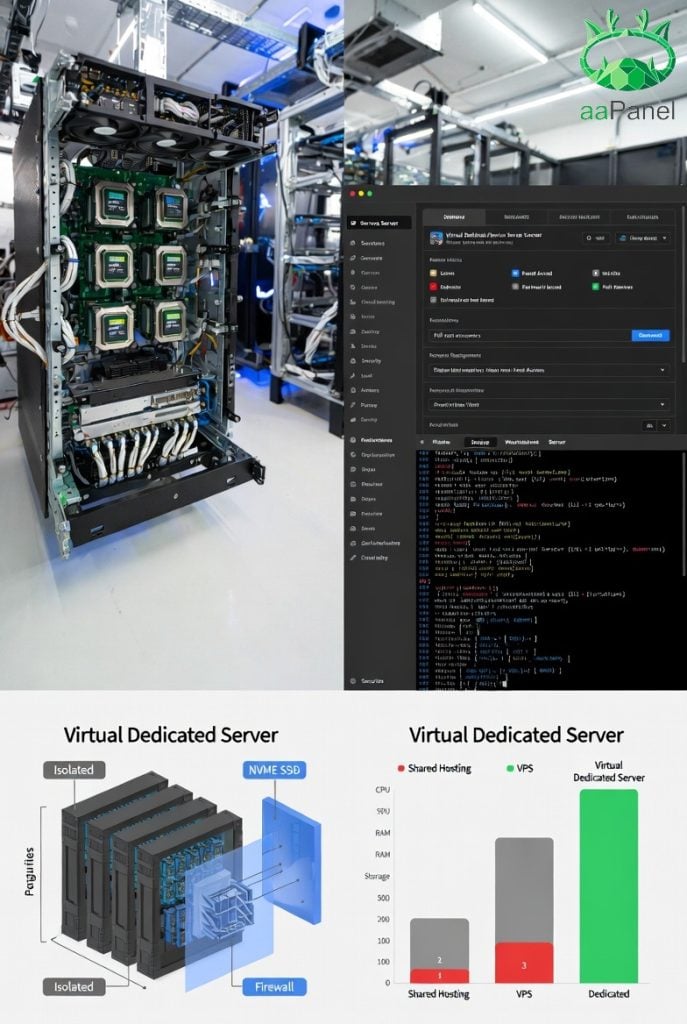
Table of Contents
- Performance That Just Feels Faster
- Root Access With Full Control
- Security That’s Actually Solid
- Scalability Without Downtime
- Simplified Yet Powerful Server Management
- Virtual Dedicated Servers Key Factors
- Virtual Dedicated Server Compared To Other Hosting Types
- Thinking About Making the Switch?
Performance That Just Feels Faster
The first thing you notice? Your site runs smoother. Shared hosting means you’re fighting with a ton of other sites for the same CPU, memory, and disk access. On a VDS, you get your own cut of everything.
You’re guaranteed a set number of CPU cores, a fixed amount of RAM, and your own storage space. That means your pages load faster, your database queries whip by, and your site can actually handle a crowd. For WordPress sites with lots of plugins, online stores during big sales, or membership sites with lots of active users, the improvement is obvious.
Modern Hardware That Powers VDS Plans
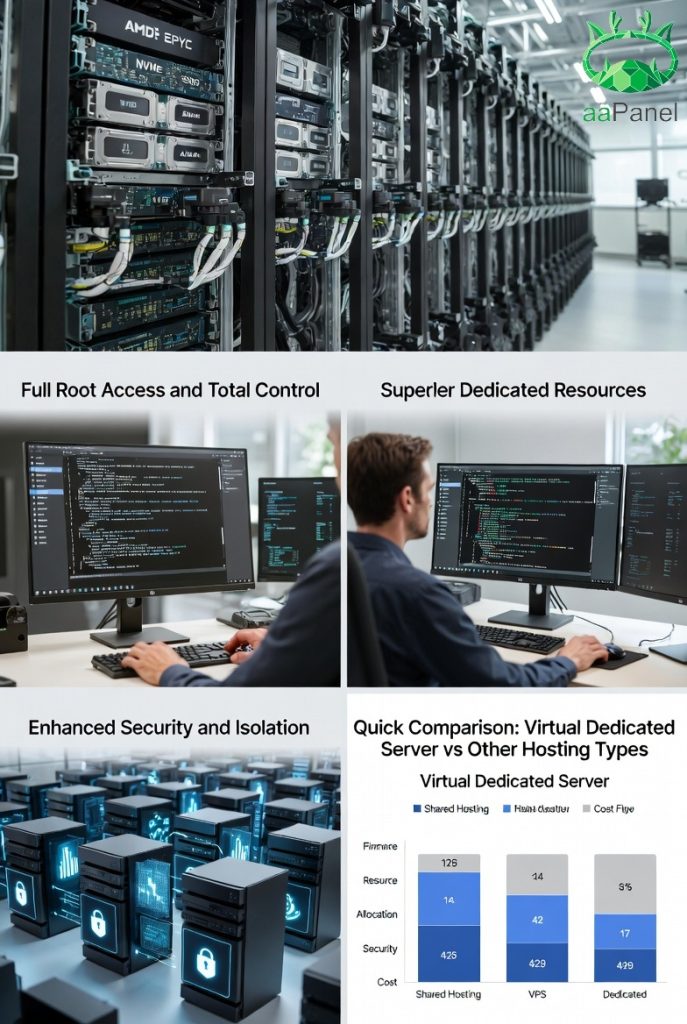
Most providers now run VDS plans on the latest AMD EPYC or Intel Xeon chips, paired with NVMe SSDs. Translation: it’s fast. You get low latency, high input/output speeds (IOPS), better Core Web Vitals scores—the works. Your visitors notice.
Root Access With Full Control
One of the best parts of having a virtual dedicated server is root access. You’re the boss. Install any software, tweak the server settings, pick your favorite Linux distro like Ubuntu, Debian, AlmaLinux, whatever. Set up your own firewall rules. Compile stuff from source code if you want. Shared hosting won’t let you do any of that. Even most VPS setups don’t give you this much freedom.
A lot of people add a server control panel to keep things simple, but you always have full access underneath.
Security That’s Actually Solid
Security is just better on a VDS. Your server is totally separate from everyone else’s. On shared hosting, if someone else’s site gets hacked or uses up all the resources, your site can get hit too. With a VDS, your environment runs in its own container or virtual machine. If one tenant gets malware, it doesn’t touch you.
Practical Security Features You Can Enable
- Custom iptables or firewalld rules
- Use Fail2Ban or CrowdSec to stop brute-force attacks
- Tailor ModSecurity to your apps
- Stay up to date with kernel patches and harden your configs
- Set up private networking for internal stuff
You get real, layered security that shared hosting just can’t offer.
Scalability Without Downtime
Growing? With a VDS, scaling is straightforward. Most good hosts let you bump up your CPU, RAM, storage, or bandwidth without much or any downtime. Start with 4 vCPU and 8 GB RAM, then scale up to 16 vCPU and 64 GB as your traffic climbs. Some hosts even let you add resources on the fly without needing to restart.
That’s way better than shared hosting, where you hit a wall and have to switch plans. And you don’t need to jump straight to expensive physical servers.
A Smart Middle Ground
VDS hosting sits right between VPS and full dedicated servers when it comes to price. You only pay for what you actually use, and you don’t have to mess with physical hardware. Entry-level plans usually start around $20–40 a month, and even the premium options don’t reach the cost of real dedicated servers.
Compared to the big cloud providers, VDS typically gives you more bang for your buck, especially if your workload is steady and doesn’t need to scale up and down all the time.
Simplified Yet Powerful Server Management
Server management doesn’t have to be a headache. These days, most providers hand you a clean, easy-to-use dashboard. You get one-click OS reinstalls, simple snapshot backups, and built-in monitoring tools. Toss in some automation scripts, cron jobs, and maybe an orchestration tool like Ansible, and suddenly your Server Management Workflow feels lighter. Stack up server management software with nginx, PHP-FPM, MySQL or MariaDB, and Redis, then add monitoring with Netdata or Prometheus and you’re set for smooth sailing.
Honestly, once you’re past the setup phase, you barely have to touch it. Most people spend just a few minutes a week on maintenance.
Virtual Dedicated Servers Key Factors
Virtual Dedicated Servers come into their own in a bunch of real-world situations:
- WordPress or WooCommerce sites that have outgrown shared hosting limits
- Smaller e-commerce shops that need checkout to always work, no matter what
- Development or staging environments for agencies who want flexibility
- Game or voice servers that can’t handle lag or shared CPU
- SaaS apps or APIs where response times have to stay sharp
- Hosting multiple client sites where isolation and stability matter
Every one of these cases gets a real lift from dedicated resources and full control and stuff you just can’t count on with shared hosting or entry-level VPS.
Virtual Dedicated Server Compared To Other Hosting Types
If you want the quick version, here’s how Virtual Dedicated Servers stack up against shared hosting, plain VPS, and full-on dedicated servers:
| Hosting Type | Dedicated Resources | Root Access | Isolation Level | Scalability | Typical Monthly Cost | Best For |
|---|---|---|---|---|---|---|
| Shared Hosting | No | No | Low | Limited | $3–15 | Beginners, small blogs |
| Standard VPS | Partial | Yes | Medium | Moderate | $10–50 | Light to medium sites |
| Virtual Dedicated Server | Yes | Yes | High | High (vertical) | $20–120 | Growing sites, e-commerce |
| Physical Dedicated Server | Yes | Yes | Very High | High (hardware) | $100–500+ | Enterprise, extreme workloads |
Thinking About Making the Switch?
Switching to a Virtual Dedicated Server isn’t about pinching every penny. It’s about locking in performance, control, and the confidence that your site won’t buckle when it matters. With dedicated resources, root access, solid isolation, and pricing that makes sense, VDS is a smart move up from shared hosting and a way better value than paying for bare metal you don’t fully use.
If your current host throttles your site when traffic spikes, blocks you from installing what you want, or leaves you open to other users’ security messes, VDS fixes all that. Fast.
So, take a few minutes and look at your current setup. Check your traffic, your resource needs, and what keeps frustrating you. If you see slowdowns, limits, or constant headaches, moving to a virtual dedicated server is like trading a bike for a sports car. Same road, whole new experience!